
Well Control, Choke Manifold
The choke manifold is a vital part of the well-control system. Its primary function is to regulate backpressure on the well while circulating out a kick. At the center of the manifold lies the panic line, which provides the least restricted flow path directly to the flare pit. In extreme situations where the well cannot be controlled, this line allows fluids to be safely diverted and flared at a distance from other equipment.
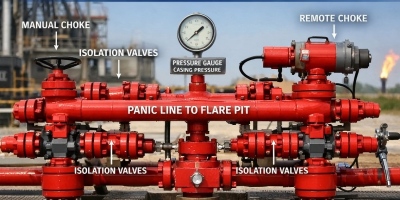
The manifold is typically equipped with both a manual choke and a remote-controlled choke. This redundancy ensures continuous operation, even if one choke must be replaced due to erosion. Each side of the manifold can be isolated by valves, further enhancing reliability. A pressure gauge is installed on the choke line to monitor casing pressure. However, when the choke line is particularly long, the pressure drop must be considered when interpreting readings.
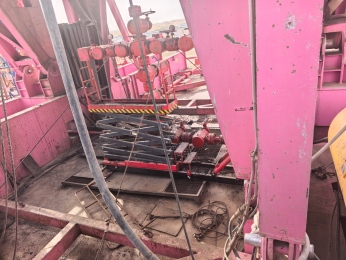
Drilling chokes used in well-control operations are built to withstand harsher conditions than standard production chokes. Mud circulated out of the well often contains solids, which can cause erosion and wear a choke quickly. Solids may also plug the choke, making redundancy essential. For this reason, at least two chokes are always installed to maintain operational safety. Several choke designs are commonly used in the industry. One design employs a plug-type choke, where a plug moves into or out of an orifice to restrict flow. Another design uses carbide plate chokes, consisting of two rotating plates with circular openings. By rotating, the plates adjust the available flow area, providing precise control over the circulation rate.
