
Three-phase Separators in The Oil & Gas Industry
In production facilities, the three-phase separator is one of the key pieces of equipment to guarantee operational continuity and fluid quality. Its function is simple in concept: to separate oil, gas and produced water. However, their performance is directly dependent on the internal design, process conditions, and configuration adopted.
The process begins with the entry of the multiphase flow into the vessel through an inlet device(baffle, cyclone or distributor),whose objective is to dissipate energy and promote a first primary separation due to density differences. The free gas rises towards the upper section, while the liquid mixture decants towards the bottom.
In the liquid zone, gravitational separation between crude oil and water occurs. Interface level control is critical: poor calibration impacts efficiency, generates water carryover in the oil or hydrocarbons in the produced water. The gas, before leaving, passes through mist extractors or vane pack to reduce the content of entrained liquids.
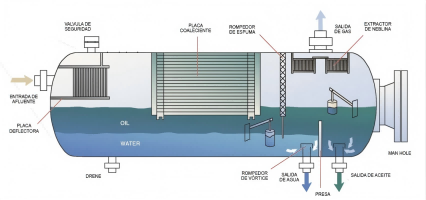
Typical configurations:
Horizontal separator:
It is the most common configuration in terrestrial production. It offers a larger liquid-liquid interface area and better handling of high gas flows. It is preferred when the gas-oil ratio is high or there are significant variations in flow.
Vertical separator:
Used when solids content is relevant or floor space is limited. It performs better against large liquid caps, although less liquid-liquid separation area compared to horizontal one.
Two-phase separator in series+ electrostatic treater:
Configuration used when more demanding dehydration of crude oil is required prior to export.
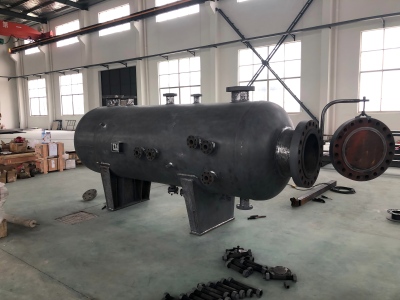
Free water knock out:
Primary separator used in oil production to remove free water from crude oil produced prior to other treatment stages to reduce load on the main separator.
Actual performance depends on variables such as pressure, temperature, PVT properties, droplet size, and residence time. Unnecessary oversizing impacts capex. A tight design with no margin compromises operational stability. A three-phase separator is not just a vessel, it is the first link in crude oil quality, water treatment efficiency, and gas compression system stability. To design it well is to protect the entire production chain.
