
The Difference Between PSV and PRV
In the industry, it’s common to hear people use PSV and PRV interchangeably. However, ASME BPVC section I, ASME BPVC section VIII division 1, API 520, API 521, and the national board inspection code(NBIC) clearly distinguish these pressure relief devices.
Understanding these differences is essential for professionals in maintenance, instrumentation, mechanical integrity, and process safety.
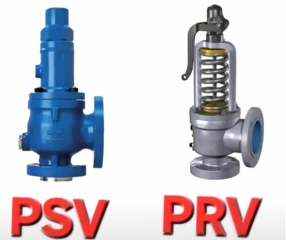
1, PSV(pressure safety valve)
-Primarily designed for steam, gas and air service.
-Features rapid” pop action” opening when the set pressure is reached.
-Its purpose is to quickly discharge the fluid and protect equipment from dangerous over-pressure conditions.
Typical applications:
-Power boilers(ASME section I)
-Steam pressure vessels
-Gas systems
-Steam generators
-Super-heaters
2, PRV(pressure relief valve)
-Primarily liquid service.
-Opens gradually(modulating action) as system pressure increases.
-Controls over-pressure smoothly without a sudden full discharge.
Typical applications:
-Pumps
-Hydraulic systems
-Process piping
-Water systems
-Oil systems
-Liquid hydrocarbon services
Classification according to ASME & The National Board
-Safety Valve: designed for steam and gas service with pop action.
-Relief Valve: designed for in-compressible liquid service with modulating action.
-Safety Relief Valve: suitable for either gas or liquid service, depending on its design and certification.
-Pilot-operated Safety Relief Valve(POSRV): uses a pilot valve to control operation, ideal for high-pressure and high-capacity applications.
-Temperature and Pressure Relief Valve(TPRV): protects equipment against both excessive pressure and excessive temperature.
A common mistake
Many professionals refer to every pressure relief device as a PSV. From a technical and code-compliance perspective, however, a safety valve, a relief valve, and a safety relief valve are not the same device.
