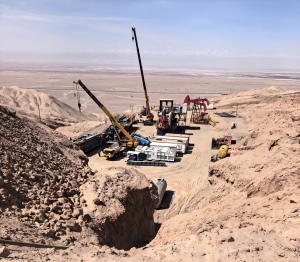
Rod pumping
Introduction
Rod pumping, commonly known as beam pumping or sucker rod pumping, is one of the most widely used artificial lift methods in the oil and gas industry.
Definition and function
Rod pumping: A mechanical lifting technique where a surface motor drives a reciprocating motion that moves a downhole pump via a string of sucker rods. The pump lifts fluid from the reservoir to the surface.
Key components
-Surface equipment
Prime mover: usually an electric motor or gas engine that provides the energy operate the system.
Gear reducer: Adjusts the motor’s speed and torque to suitable levels for pumping.
Walking beam & Pitman arm: Converts rotary motion into the up-and-down movement needed to operate the sucker rods.
Samson post & Horse head: Support and guide beam motion.
-Subsurface equipment
Sucker rod string: a series of threaded steel rods that transfer motion from the surface to the downhole pump.
Tubing: a conduit through which the lifted fluid flows to the surface.
Downhole pump: typically a barrel-and-plunger system that lifts the fluid via a reciprocating piston motion.
Operating principle
The motor rotates the crank, which moves the pitman arms and the walking beam in a reciprocating motion.
This motion is transferred downhole through the sucker rod string. The rod string moves he plunger inside the downhole pump, creating a pressure differential that lifts fluid into the tubing and up to the surface.